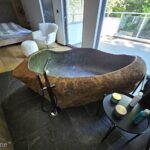

Natural Stone vs Stone Resin, Solid Surface and “Onyx”: How to Tell Real Stone from Composite
Table of Contents
Where the confusion around “stone” bathtubs, sinks and shower trays comes from
In bathroom product offers, the word “stone” appears very often today. Stone bath, stone resin, solid stone, solid surface, stone composite, onyx shower, onyx sink. For a customer who does not work with materials every day, these terms sound similar. They all suggest something heavy, durable, mineral and more prestigious than acrylic.
In practice, completely different products are hidden behind these names.
Natural stone means a product made from real stone – for example marble, onyx, granite or river stone. In the case of premium bathtubs, sinks and shower trays, the most important question is this: was the product made from a single block of natural stone, or is it a cast product made from a mineral-resin mixture?
Stone resin and solid surface are most often composites. Their base is crushed or ground mineral, for example marble or quartz, combined with resin. The mass is cast in a mould, cured and surface-finished. Such a product can be solid, aesthetic and practical, but it is not the same as a bathtub carved from a single block of stone.
Products called “Onyx” are a separate category. Here the confusion is even greater, because the word “onyx” can mean a real stone, but it can also be a trade name for a shower system, panel or composite product with a glossy surface. In user discussions, you can often see surprise when someone discovers that their “onyx shower” is not natural onyx, but a product made from resin or a composite panel.
This is not a dispute about names. The material determines the weight, installation method, tactile feel, heat retention, resistance to cracking, renovation possibilities and how the product will look after 10 or 20 years.

What stone resin and solid surface are really made of
Stone resin is usually described as a mixture of finely ground minerals and polymer resin. Depending on the manufacturer, it may contain marble dust, limestone aggregate, quartz or another mineral filler. Resin, pigments, technological additives and a finishing layer are added to this.
Solid surface works in a similar way, although specific formulas differ between brands. The material is intended to be visually uniform, non-porous, easy to shape and relatively simple to maintain. That is why it is used not only for bathtubs and shower trays, but also for countertops, sinks and built-in elements.
Manufacturers often emphasise that their material contains “up to 80% natural stone”. This sounds very strong, but it must be understood precisely. It does not mean that 80% of the product is solid stone. It means that the mass may contain a large proportion of aggregate, dust or mineral that has been combined with resin.
The simplest analogy is a wooden board and MDF. Both are connected with wood. One is a solid piece of material, the other is made from ground fibres and binder. MDF can be even, stable, easy to manufacture and very practical, but it does not become solid wood because of that.
In the same way, crushed marble combined with resin does not become a marble block. It is a composite material. It may be good, but it should be honestly named.

Natural stone is not a coating
With natural stone, the most important thing is material continuity. If a bathtub or sink is made from one block, the stone structure runs through the entire thickness of the product. The edge, underside, drain area and usable surface are all part of the same material.
Composites can achieve a very convincing visual effect. The surface can be perfectly smooth, matte, satin, glossy, white, black, marble-like or slate-like. The problem is that appearance does not always tell the truth about the structure.
This is exactly why experienced buyers ask for photos of the underside, edges and cross-sections. Natural stone has its pattern also beyond the area shown in a catalogue photo. A composite may look perfect from above, but its structure comes from casting technology.
This does not mean that composite is bad. It only means that it should be compared with composite, not with a block of stone.

“Onyx showers” and the problem of marketing names
Natural onyx is an exceptional stone. It has depth, layering, often partial translucency and a very distinctive pattern. A real onyx sink or bathtub is a heavy, expensive and unique product.
However, there are products on the market described as “Onyx” that are not made from natural onyx. These are often shower panels, shower trays or wall systems made from composite material. The name suggests stone, but the actual composition may be based on resin, mineral fillers and a decorative surface.
In user discussions, this exact moment of surprise often appears: one person writes about an “onyx shower”, and another explains that it is not stone onyx, but a system made from plastic or composite. This is how marketing language works. A word associated with stone becomes the name of a product, and the customer stops distinguishing the material from the visual effect.
That is why with names such as “onyx sink”, “onyx shower”, “stone tub” or “stone bath”, one question must be asked: is this natural stone, or a composite product named in a way that refers to stone?

Touch, temperature and “plastic feel”
One of the most common complaints about acrylic is that it “feels like plastic”. This is not only about surface temperature. It is about sound, lightness, flex, the way light reflects and the impression of a thin shell.
Stone resin performs better than acrylic in this respect. It is heavier, stiffer and more massive. To the touch, it can be pleasant, perfectly smooth and slightly warm. For many people it is a good compromise: it looks more solid than acrylic, while being easier to install than a full stone block.
Natural stone gives a different experience. It is mineral, cooler at first touch, more “alive” in its structure. It does not have the perfect uniformity of composite. It has micro-texture, a natural pattern, tonal transitions, veins, small irregularities and a weight that cannot be recreated by casting.
Stone resin can be described as a perfectly smooth, slightly warm composite. Natural stone is a mineral material, with its own pattern and subtle irregularity. In a luxury bathroom, this difference is visible not only to the eye, but also to the hand.

Heat retention: what marketing promises and what physics explains
Stone resin manufacturers often emphasise very good heat retention. Product descriptions include claims about bathing comfort and long-lasting temperature. At the same time, users in discussions are divided. Some are satisfied, while others point out that a large composite bathtub with a greater volume of water does not always retain heat as long as they expected.
There is no single simple answer here, because heat retention depends on several factors: the mass of the material, wall thickness, the initial temperature of the bathtub, the amount of water, room temperature and installation method.
Stone resin can give a pleasant first impression because its surface is not as mineral-cold as stone. Skin contact feels comfortable more quickly. Natural stone needs a moment to absorb the water temperature, but once a large mass of material warms up, it acts like a heat accumulator.
Cast iron works in a similar way. At first it needs to be warmed up, but later it retains temperature very well. That is why users often say that cast iron and stone bathtubs “keep heat for hours”. This is not material magic, but mass and the ability to store thermal energy.
In practice, the comparison axis looks like this:
Acrylic is light and quickly pleasant to the touch, but it does not give a sense of mass. Stone resin is more stable, smoother and more comfortable than acrylic. Natural stone has greater thermal inertia and the most mineral feel. For a short bath, the difference may not matter much. For a long soaking bath, the mass of the material begins to matter.
Rigidity, flex and cracks
In shower trays and bathtubs, the key issue is whether the product moves under load. Acrylic shower trays are often criticised for flexing. If the tray moves, the silicone around the walls and drain moves as well. Over time, cracks, leaks and grout problems may appear.
Stone resin is stiffer than acrylic, but it still remains a composite. In many installation instructions for shower trays made from this material, there is a requirement for full support on mortar, concrete or a stable base. This is very important. If there is an empty space underneath or point loading, stresses may concentrate around the drain or corner.
On forums, there are reports of stone resin shower trays that cracked after several years around the drain area. In such cases, it is difficult to determine later what the main cause was: material quality, installation error, uneven support, movement of the substrate or overloading.
Natural stone also requires good installation. Because of its weight, it needs a stable base and properly planned transport. The difference is that a full block of stone does not behave like a thin-walled cast product. There is no elastic flex underfoot. The core is stone through the full thickness.
This is one of the most important structural differences: a composite can be very good, but its durability depends on the formula, thickness, resin quality and installation. Natural stone relies on mass and material continuity.
Durability, scratches and repairs
Stone resin and solid surface are often advertised as resistant and repairable materials. To a large extent, this is true. Small scratches can be sanded, minor chips can be filled, and the surface can be refreshed. This is one of the advantages these materials have over cheap acrylic.
The problem begins with deeper damage: structural cracks, damage around the drain, staining, resin ageing, local surface discolouration or coating damage. Then the repair may be visible, short-lived or dependent on a repair kit from a specific manufacturer.
One more problem often appears in user reports: complaints and warranty claims. The manufacturer may decide that the damage resulted from installation, cleaning agents or improper use. The customer is left with a product that was supposed to be “easy to repair”, but in reality requires costly intervention or replacement.
Natural stone can also be damaged. It can be scratched, stained or become matte if it is used incorrectly or not properly protected. But its renovation is based on a different logic. You do not repair a coating that imitates the material. You sand and polish the material itself.
This is known from granite countertops, marble floors, stairs and windowsills. After years, a thin surface layer can be removed, the stone can be polished, refreshed and impregnated again. In practice, you reveal another layer of the same material.
Composite durability is strongly connected with the quality of the surface and resin. Natural stone has the potential for repeated renovation.
What the “percentage of stone” in stone resin really means
The claim “up to 80% natural stone” appeals to the imagination. A customer may think: if the product has 80% stone, it is almost the same as stone. This is the most common misunderstanding.
In a composite, mineral is a component of the mass. It may improve weight, rigidity, appearance and surface feel. But the binder remains resin. It is the resin that determines how the material ages under the influence of temperature, chemicals, UV radiation, stress and everyday use.
In a natural block, stone is not an additive. It is the structure.
The difference is easiest to see in renovation. If a wooden countertop is made from solid wood, it can be sanded many times. If it is veneered, the possibilities are limited by the thickness of the layer. If it is made from laminate board, surface damage is a completely different problem.
It is similar with a bathtub or sink. Stone aggregate in resin does not offer the same renovation potential as solid stone.
The second life of the product
In a premium bathroom, durability should not mean only that the product will not crack for several years. It also matters what can be done with it after 10, 15 or 20 years.
Stone resin is most often restored locally: sanding small scratches, filling chips, correcting the surface, possibly replacing the element. With a good-quality material, this can work very well. With a lower-quality one, or with more serious damage, the effect can be limited.
Natural stone has a different “second life”. It can be sanded, polished, the level of gloss can be changed, some stains can be removed, and impregnation can be renewed. A well-made stone bathtub or sink does not have to disappear from the bathroom during the next renovation. It can remain the central element of a new interior concept.
This is also important from a cost perspective. A cheaper product that has to be replaced after a few years is not always cheaper in the long term. A more expensive product that can be renewed may prove more rational over many years.

Aesthetics and property value
Stone resin is a good solution for clean, modern bathrooms. It has a repeatable colour, predictable shape and catalogue-style aesthetics. The architect knows what they will get. The investor knows how much they will pay. Installation is easier than with a large stone block.
Natural stone works differently. It does not only fill the project. It often becomes its most important element.
In English-language discussions about luxury bathrooms, the terms “statement piece” and “spa-like centerpiece” often appear. This is not empty marketing. It refers to a product that changes the perception of the entire space.
A marble bathtub, a river stone sink or a natural stone shower tray does not look like a typical catalogue element. It has its own pattern, weight and presence. In a private bathroom, it builds the atmosphere of a home spa. In a hotel or villa, it raises the perception of the standard. In a premium property, it can be one of those details that distinguish an ordinary renovation from an investment in quality.
There are two scenarios here. The first: the bathroom needs to be done correctly, aesthetically and within a reasonable budget. Then stone resin may be a good choice. The second: the bathroom is meant to be a wellness space, part of a luxury property or an interior that should make an impression for years. Then natural stone begins to have an advantage that cannot be reduced only to price.
Natural stone, warmth and wellbeing
A bathtub made from natural stone is not a medical device. It should not be credited with healing properties. However, it is fair to say that stone fits very well into the ritual of a restorative bath.
The basis is heat. A large mass of stone, once warmed, releases temperature more slowly than lightweight materials. This resembles the logic of hot-stone therapy: stable, long-lasting heat helps relax muscles, reduce tension and bring the body into a state of rest. Studies on heat therapies highlight the effect of temperature on tissue relaxation, circulation and the subjective reduction of tension.
Then there is water. A warm bath itself has a relaxing effect, especially in the evening. When combined with mineral salts, it creates an effect close to a home version of a mineral bath. Magnesium, calcium and potassium are associated with thermal and restorative bathing. This is not about a promise of treatment, but about creating conditions in which the body can calm down more easily.
A stone bathtub strengthens this ritual through three things: mass, heat retention and the perception of the material. Bathing in a heavy, mineral bathtub does not give the same feeling as bathing in a lightweight acrylic shell. It is a more physical, calmer experience.
That is why natural stone often appears in spa, wellness, boutique hotel and private bathroom projects designed as places of rest, not just hygiene.
How to check whether a “stone tub” or “onyx sink” is really made of stone
The simplest way is not to rely on the trade name. You need to ask the seller specific questions.

Is the product made from a single block of natural stone?
The answer should be clear. Yes or no.
If the seller answers: “it is stone material”, “mineral stone”, “stone blend”, “onyx effect”, “solid stone surface” or “engineered stone”, you need to ask further. These terms often indicate a composite.
What is the net weight?
Full stone will be clearly heavier than a composite product of a similar size. Weight alone is not enough as the only proof, but it is a very strong indicator.
For bathtubs, sinks and shower trays, it is worth asking separately about the net weight of the product and the gross weight with packaging.
Can I see the underside, edges and technical areas?
Natural stone should have the same structure throughout the entire cross-section. Edges, the underside and the area around the drain are good places to assess this. If a layer, coating, different core or decorative surface is visible, it may indicate a composite.
Does the product have a lacquered or masking coating?
With natural stone, good workmanship is based on block selection, sanding, polishing and impregnation. If the product requires a thick masking coating, it is worth asking what that coating is hiding and how it will age.
What does renovation look like after 10-15 years?
This is a very good test question.
With a composite, the answer usually concerns repair kits, local filling, sanding scratches or replacing the element.
With natural stone, the answer should concern sanding, polishing, removing stains and re-impregnation, similar to stone countertops, floors or stairs.
When stone resin makes sense
Stone resin has its place and does not need to be depreciated. It is a good choice when the project requires repeatability, lower weight, faster installation and a predictable budget.
It works in apartments, investment properties, mid-range hotels and projects where series consistency is the most important factor. If many identical shower trays or bathtubs need to be installed, composite simplifies logistics.
It also makes sense when the building structure does not allow for a very heavy element, or when the customer wants a more solid effect than acrylic but does not plan to invest in full stone.
There is one condition: you need to know that you are buying a composite. Good stone resin can be practical, aesthetic and reasonable. The problem begins only when it is sold or perceived as natural stone.
When it is worth choosing real stone
Natural stone makes sense where the product is meant to be unique, durable and capable of being restored after years.
It is worth considering when the bathtub or sink is meant to be the central element of the bathroom. When the project concerns a premium home, villa, boutique hotel, spa zone, wellness room or an interior where the material is meant to build atmosphere, not merely fulfil a functional role.
Stone is also a good choice for customers who do not want a repeatable product. Every block has its own pattern. Marble will not look like a printed marble pattern. Onyx will not be an imitation of onyx. River stone will not be a product designed by a mould, but a worked natural boulder.
Most importantly, natural stone does not end at the surface. It is the same material throughout the entire mass. This gives it weight, character and a renovation potential that composites cannot always match.
A conscious choice instead of a battle of materials
Not every customer should buy a natural stone bathtub. Not every project requires it. Natural stone means greater weight, higher cost, more demanding transport, a solid base and acceptance of natural material differences.
Stone resin and solid surface can be very good materials if they are used properly and described honestly. They offer predictability, a modern look and easier logistics.
But natural stone is a different product category. It is not a mixture of aggregate and resin. It is not a surface with a stone effect. It is not the marketing name “Onyx”. It is a material extracted from nature and worked so that it can become a bathtub, sink or shower tray.
The most reasonable question is not: “which material is always better?”. A better question is: “what do I expect from this product in 10 or 20 years?”.
If the answer is repeatability, lower weight, a reasonable budget and fast installation – stone resin may be the right choice.
If the answer is uniqueness, natural pattern, mass, renovation, aesthetic value and the effect of a private spa – real stone will be difficult to replace.