
Part II: weight, floor support, installation and everyday care. Before ordering a natural stone bathtub, confirm its actual weight, the floor support, the delivery route and the drainage connection. This guide answers practical questions about planning the installation and caring for the stone afterwards.
Table of Contents
For introductory questions, see Part I: common questions about natural stone bathtubs. To compare available designs and materials, visit our stone bathtub collection.
How much does a natural stone bathtub weigh?
Use the weight of the specific tub, not a general average. Weight depends on the stone, overall dimensions, internal shape and the thickness of its walls and base. Two tubs with similar external dimensions can have different weights.
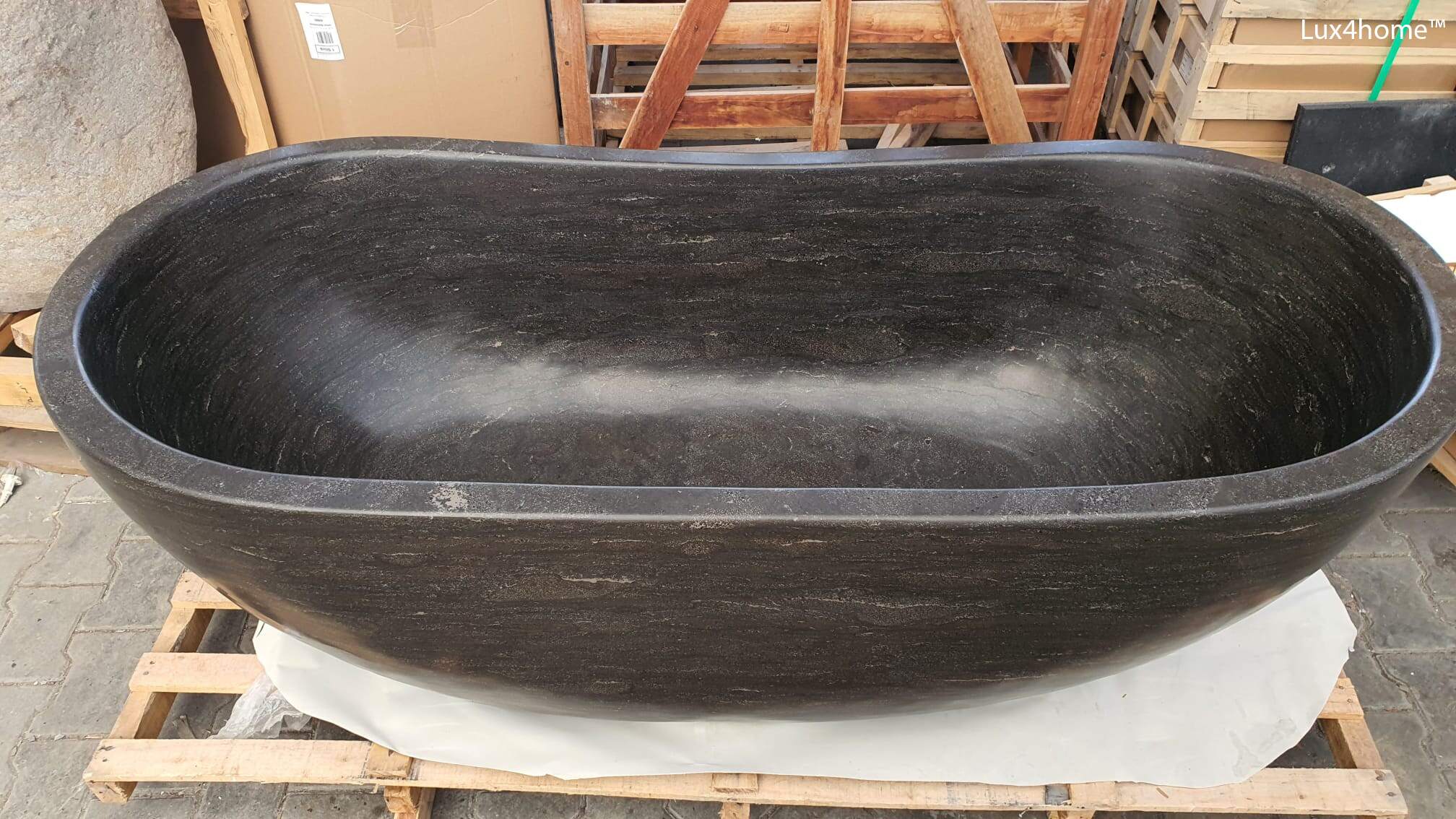
For context, the Flumen example documented in this guide measures approximately 200 × 98 × 68 cm and weighs around 1,000 kg. This is an example, not a specification for every Flumen bathtub. Ask for the confirmed net weight of the particular piece and the packed weight needed for delivery planning.
Can my floor support a stone bathtub?
A structural engineer needs to assess the proposed location and the actual loads. A ground-floor position, a concrete building or a large bathtub base does not by itself confirm that an installation is suitable.
Supply the engineer with the tub’s net weight, intended water volume, expected occupancy, support footprint and installation drawing. The assessment also needs to account for the floor construction, condition, supporting structure and delivery route. A simple average in kilograms per square metre is not a substitute for this assessment.
Planning example: a hypothetical 1,000 kg tub containing 300 litres of water and one 100 kg user has a combined mass of approximately 1,400 kg. The water and user figures here are illustrative, not a filling recommendation or a statement that a particular floor can support the load.
Can a stone bathtub go upstairs or above underfloor heating?
It may be possible, but both the supporting structure and the floor build-up must be checked for the chosen tub. Ask the structural engineer and heating-system installer to review the location, support detail, screed and any restrictions around heating pipes or cables before the bathroom is finished.
Also check the route into the room. Stairs, lifts, landings and temporary handling equipment can introduce different loads and access constraints from the final installed position.
How should a heavy stone bathtub be moved?
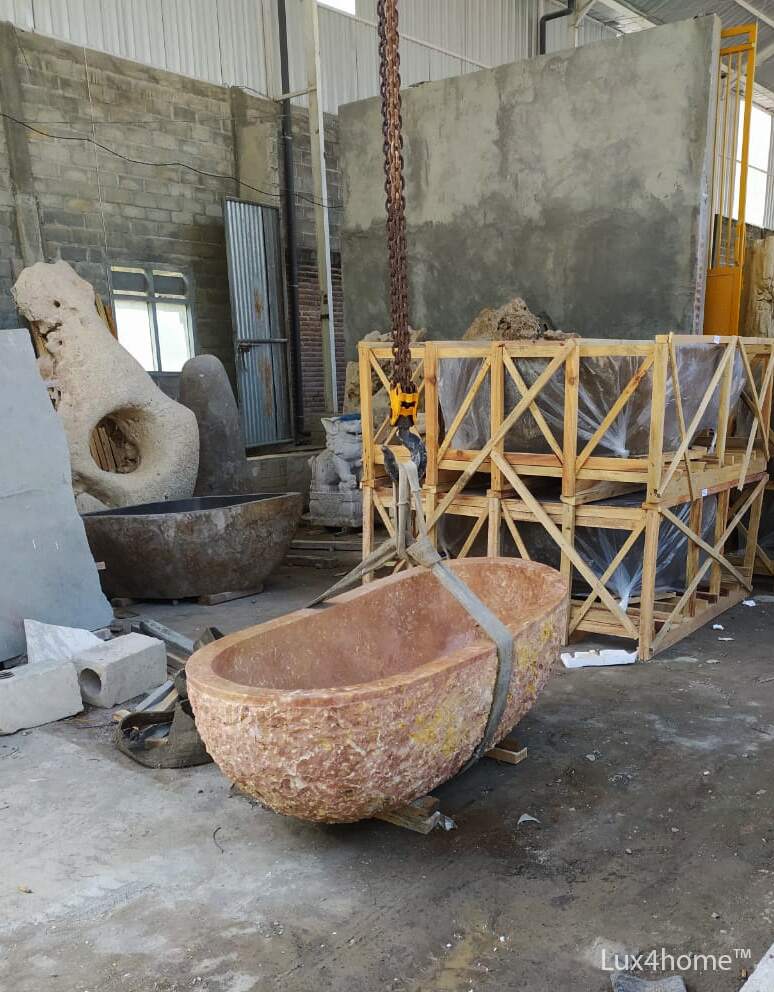
Use a specialist handling contractor with a plan for the actual tub and site. Confirm the weight, centre of gravity, permitted lifting or support points, route dimensions and unloading position before delivery.
The contractor should select suitable lifting equipment and protection for the stone and building. Do not assume a fixed number of people can safely carry the tub, and do not improvise levering against its rim or edge. General lifting principles are explained in the HSE guidance on manual handling in construction; the installation still requires a site-specific plan.


What should be prepared before installation?
Agree the installation drawing with the supplier and installer before preparing the floor or ordering drainage fittings. The drawing should identify the support requirements, drain position and connection details for the actual tub.
- Confirm the location and support: obtain the structural assessment and prepare the floor according to the agreed installation detail.
- Confirm access: check unloading space, door openings, turns and the complete route into the room.
- Coordinate drainage: check the outlet position, fitting dimensions, overflow arrangement and access for servicing.
- Position and connect: have the installer follow the supplier’s support and levelling instructions without creating unintended stress points.
- Test before handover: check connections for leaks and confirm drainage and access for maintenance.
Which waste fitting does a stone bathtub need?
The fitting must match the tub’s outlet dimensions and whether the tub has an overflow. There is no single waste fitting that suits every carved stone bathtub. Ask the supplier and plumber to confirm compatibility, sealing surfaces and service access before ordering.
A click-clack waste may be suitable for a particular design, but the opening mechanism alone does not establish compatibility. Do not rely only on a photograph or an assumed national standard.
What information should I send to the supplier and installer?
Use this checklist before committing to the installation:
- The selected model or individual stone piece, with its confirmed dimensions and net weight.
- The proposed bathroom location, floor construction and structural assessment.
- The intended water volume and occupancy for load assessment.
- A drawing showing the support footprint, drain position and connection requirements.
- Delivery access dimensions, unloading arrangements and the handling contractor’s plan.
- Details of underfloor heating, waterproofing and access for future maintenance.
If you are still assessing workmanship, read our guide to checking a stone bathtub or sink before purchase. Ask for written clarification of surface treatments, repairs and care requirements rather than inferring quality from price alone.
How do you clean and seal a natural stone bathtub?
Follow the care instructions for the actual stone, finish and any treatment already applied. For routine care, use a suitable neutral stone cleaner, rinse and dry with a soft cloth. Avoid abrasive products and acidic cleaners on acid-sensitive stone such as marble. The Natural Stone Institute’s care guide explains why identifying the stone matters.
Do not assume every stone needs the same sealer or a fixed resealing interval. Confirm whether sealing is needed, which product is suitable for the intended bath use, and its application and curing instructions. A sealer is not a repair for a crack or a leaking drain connection.
Are stone baths difficult to keep clean?
Routine care is easier when soap residue and water deposits are removed regularly with products suitable for the stone. The finish, local water hardness and cleaning routine all affect maintenance. Treat a persistent mark according to its cause rather than reaching for an acidic bathroom descaler or abrasive pad.
Does a stone bathtub keep water warm?
Stone exchanges heat with the water and the surrounding room. A cold tub initially absorbs heat from warm water, so its starting temperature matters. Cooling during a bath also depends on the amount of water, exposed surface, room temperature and air movement. Material alone does not justify a fixed promise about how long the water will stay warm.
For a garden or terrace, also consider weather exposure, drainage and the suitability of the particular stone and installation. See our outdoor river stone bathtub project.

How long can a natural stone bathtub last?
Service life depends on the stone, manufacture, installation, use and maintenance. Natural stone can be durable and some surface damage can be restored, but it is not indestructible. Impact, unsuitable cleaning products, movement or unsupported areas can damage a tub. Have a stone specialist assess any crack or persistent leak before continued use.

Planning a specific installation? Contact Lux4home with the model and project details so that the product information can be coordinated with your structural engineer and installer.